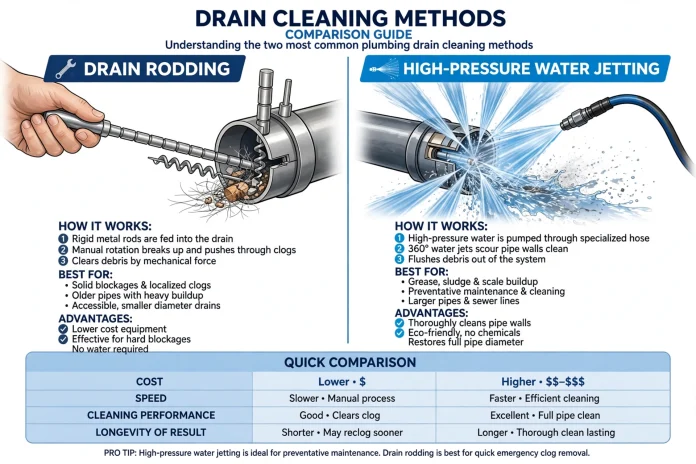
The blocked drains Portsmouth homeowners encounter can have different causes, from a localised build-up of waste to heavy grease deposits or accumulated silt. The most effective way to clear a blockage depends on what is obstructing the pipe and how far the problem extends. Two commonly used methods are drain rodding and high-pressure water jetting, each with its own advantages and limitations.
Drain rodding uses flexible rods to mechanically break through or dislodge an obstruction, while high-pressure water jetting uses powerful streams of water to remove blockages and clean the internal surfaces of pipes. Drainage specialists such as DrainBoss assess the problem before determining which approach is appropriate. Although both methods can restore drainage, the best choice depends on the type and location of the blockage, access to the pipework and the condition of the drainage system.
How Does Drain Rodding Work?
Drain rodding is a mechanical method of clearing blockages using a series of flexible rods that can be connected to reach further into a drainage pipe. The rods are usually fitted with threaded connections and interchangeable attachments designed to push through, break apart or retrieve certain obstructions. The operator applies controlled pressure and rotation to work through the blockage and restore water flow.
The rods are typically introduced through an inspection chamber, rodding eye or another suitable access point. As the operator advances the tool, additional sections can be connected to reach obstructions further along the pipe. Different attachments may be used depending on the suspected blockage, although the effectiveness of the method depends on the pipe layout and available access.
Rodding is particularly useful for relatively simple, localised obstructions, including compacted waste or accumulated paper. The equipment is straightforward and does not require a high-pressure pump or specialist water supply. However, navigating multiple bends or reaching distant blockages can be difficult. Rodding may also create a passage through an obstruction without removing deposits that remain attached to the pipe walls, particularly grease and hardened residue.
How Does High-Pressure Water Jetting Work?
High-pressure water jetting uses specialist equipment to deliver a concentrated flow of water through drainage pipes. A powerful pump forces water through a flexible hose fitted with a specially designed nozzle. The resulting jets loosen accumulated deposits, break apart certain obstructions and help remove debris from the drainage system.
Different nozzles serve different purposes. Rear-facing jets can help propel the hose along the pipe while cleaning its internal surfaces, whereas forward-facing jets may be used to tackle obstructions ahead of the nozzle. The combination of water pressure and flow allows the equipment to reach areas that may be difficult to clean thoroughly with mechanical rods.
This method is particularly effective against grease, fat, silt, sludge and accumulated organic debris. It can clean deposits from a substantial portion of the internal pipe surface rather than simply opening a narrow passage through the blockage. However, loosened material must be managed appropriately to prevent it from accumulating elsewhere in the drainage system.
The operating pressure, water flow and nozzle must be selected according to the pipe diameter, material, condition and type of obstruction. Older pipes, weakened joints and damaged sections may not tolerate aggressive cleaning. High-pressure jetting therefore requires suitable equipment, trained operators and an assessment of potential risks before work begins.
Drain Rodding vs Water Jetting: Key Differences
Although both methods are used to clear blocked drains, they differ in how they remove obstructions, the equipment they require and the results they can achieve. Drain rodding relies on direct mechanical contact, while water jetting uses hydraulic force to loosen and remove accumulated material.
The main differences are summarised below.
| Comparison Factor | Drain Rodding | High-Pressure Water Jetting |
| Cleaning method | Mechanical pressure and movement | Pressurised water jets |
| Suitable blockages | Simple, localised obstructions | Grease, sludge, silt and various stubborn deposits |
| Pipe wall cleaning | Limited ability to remove widespread deposits | Can clean a larger area of the internal pipe surface |
| Equipment required | Flexible rods and attachments | High-pressure pump, hose and specialist nozzles |
| Access requirements | Suitable inspection chamber or rodding point | Suitable access point and adequate water supply |
| Reach | Restricted by rod length, bends and pipe layout | Flexible hose can negotiate many pipe layouts |
| Cost considerations | Often less equipment-intensive for straightforward jobs | Costs depend on equipment, accessibility and cleaning complexity |
| Main limitations | May leave deposits behind or struggle with complex pipework | Requires careful pressure selection and specialist safety precautions |
An important distinction is the difference between clearing a blockage and restoring the condition of a drainage pipe. Removing enough material to allow wastewater to flow again does not necessarily mean that the pipe is completely clean or structurally sound. Grease deposits, displaced joints, cracks and other defects may remain even after drainage appears to have returned to normal.
Neither method repairs damaged pipework. If repeated obstructions are caused by a structural defect, further investigation and an appropriate repair may be necessary.
Which Method Works Best for Different Types of Blockage?
The most suitable cleaning technique depends primarily on the material causing the obstruction and how it has accumulated inside the pipe. Some blockages can be dislodged mechanically, while others require more thorough cleaning of the internal surfaces. The following situations illustrate where each method may be appropriate.
- Minor Localised Blockages. Drain rodding can be effective when an obstruction is relatively close to an accessible inspection chamber and consists of material that can be broken apart or displaced. For example, a compacted accumulation of paper or waste may respond to controlled mechanical clearing. If normal flow returns and no underlying defect is suspected, further cleaning may not always be necessary.
- Grease and Fat Build-Up. Grease can gradually accumulate along pipe walls, reducing the available space for wastewater. Rodding may open a passage through these deposits without removing much of the surrounding residue. High-pressure jetting is generally better suited to breaking down and flushing away grease build-up, although heavily hardened deposits may require additional treatment.
- Silt, Sludge and Loose Debris. Outdoor drains and surface water systems can collect sediment, leaves, soil and other loose material. Mechanical rods may dislodge compacted debris but are less effective at removing widespread sediment deposits. Water jetting can loosen and move this material, although substantial quantities may need to be collected or extracted to prevent further restrictions downstream.
- Tree Root Intrusion. Roots can enter underground drains through defective joints, cracks or other openings. Small intrusions may be removable using specialist mechanical cutting equipment or suitable jetting attachments. However, ordinary rodding and standard cleaning nozzles may be insufficient for established root masses. Removing the roots also leaves the original entry point untreated, so pipe repair may be required to prevent further intrusion.
- Hard Obstructions and Damaged Pipes. Hardened concrete, substantial mineral deposits and other rigid obstructions may resist conventional rodding and jetting. Specialist cutting equipment or excavation may be necessary, depending on the material and pipe condition. Neither cleaning method can correct a collapsed section, severely displaced joint or major structural deformation.
These examples demonstrate why the most powerful cleaning method is not automatically the most appropriate. The nature of the obstruction must be considered alongside the condition and accessibility of the affected pipework.
What Are the Risks and Limitations of Each Method?
Drain rodding is relatively straightforward, but incorrect use can damage drainage components. Applying excessive force against a solid obstruction may harm weakened joints or cause an attachment to become trapped inside the pipe. Poor handling can also result in disconnected rods being left underground, creating an additional obstruction that requires retrieval.
High-pressure water jetting introduces different risks. Water delivered at high pressure can cause serious injuries if equipment is mishandled, while inappropriate operating settings may damage deteriorated pipes or dislodge weakened components. The risk depends on several factors, including pressure, nozzle design, pipe material and the existing condition of the drainage system. Professional operators must also control hose movement, manage contaminated water and follow appropriate safety procedures.
Both methods become less suitable when the pipe has significant structural defects. A collapsed section cannot be reopened permanently by simply removing accumulated waste, while a displaced joint may continue collecting debris after cleaning. In these circumstances, repeated attempts to force equipment through the affected area can make the situation worse.
A further limitation is that successful clearance does not always identify the original cause. If a blockage results from incorrect pipe alignment, root intrusion or a damaged connection, restoring water flow may only provide temporary relief. Where structural damage is suspected, the pipe should be assessed before aggressive cleaning is attempted.
How Do Professionals Decide Which Drain Cleaning Method to Use?
Selecting an appropriate method begins with understanding the drainage problem rather than immediately choosing equipment. The location of the obstruction, the behaviour of the affected drains and any previous history of blockages can provide useful information. The pipe’s condition and the available access points must also be considered before work begins.
A typical professional assessment involves several stages:
- Identifying the affected drainage section. Establishing which fixtures, gullies or inspection chambers are affected helps narrow down the likely location of the obstruction.
- Assessing access and pipe layout. The operator considers available entry points, pipe diameter, bends and the approximate distance to the blockage.
- Evaluating the suspected obstruction. The available evidence helps determine whether mechanical clearing, water jetting or another technique is most appropriate.
- Investigating possible structural defects. A CCTV drain survey may be recommended when blockages recur, the cause remains uncertain or there are indications of pipe damage.
- Selecting and carrying out the cleaning method. In some cases, rodding may first create an opening through a blockage, followed by jetting to remove remaining deposits.
- Checking the results. Water flow can be tested after clearance, with further inspection where necessary to confirm that the obstruction has been adequately removed.
A CCTV survey is not required for every straightforward blockage. However, it can help identify cracks, displaced joints, root intrusion and other problems that cannot be reliably diagnosed from drainage symptoms alone.
The objective is to restore proper flow without unnecessarily damaging the existing pipework. Choosing between rodding and jetting is therefore a technical decision based on the specific drainage problem, rather than a matter of one method being universally superior.
Drain Rodding or High-Pressure Jetting: Which Should You Choose?
Neither drain rodding nor high-pressure water jetting is the best solution in every situation. Rodding remains a practical option for straightforward, accessible blockages that can be cleared mechanically. High-pressure jetting is often more effective when grease, sludge or silt has accumulated along the pipe walls. The right choice depends on the nature of the obstruction, the available access points and the condition of the drainage system.
If blockages keep returning or structural damage is suspected, further investigation may be necessary. Neither method can repair cracked, displaced or collapsed pipes, which may require additional work. DrainBoss can assess the blocked drains Tunbridge Wells homeowners encounter and recommend an appropriate cleaning method or repair solution. Ultimately, identifying the underlying cause is just as important as restoring water flow.