Winter has a very large impact on the humidity of a house, causing many problems to the inhabitants. The cold air lacks capacity to retain much moisture, while the home heating systems may deplete the air of moisture. From the excessively dry skin to the static electricity, the impacts of dry air differ, whereas the excessively humid air causes condensation and dampness. The comprehension of the behavior of the humidity level in the house during the winter is essential so that the inhabitants avoid damages incurred by the dryness or dampness and enjoy a reasonably comfortable environment.
Understanding Indoor Humidity Levels
It is needed to know what level of humidity in the room, in percentages. It is possible that in winter, the optimal indicator in the room, taking into account the outdoor temperatures, the insulation of the house and windows, may be several tens of percent. For example, 30-40% of air humidity inside the house will be enough to avoid the formation of ice or water on the glass.
Universal signs of insufficient or excessive air humidity in the room may be a feeling of discomfort and inconvenience, static electricity shocks, and changes in the state of furniture and clothing. However, in reality, it might not be possible to estimate the humidity level in winter. Instead of estimating the state of dryness or air humidity, it is best to use a hygrometer.
Using a Humidifier Correctly
One of the simplest methods of increasing the level of humidity indoors is a humidifier. Both portable and permanent devices are available, designed for small or large areas. As a consequence, each owner should be able to choose the equipment needed to ensure that the size of the room being heated matches the recommended or desired levels of humidity. Before using such devices it is also essential to check the current or target humidity levels.
This is because running a humidifier can damage equipment at the desired humidity levels. It is also necessary to remember to clean the humidifier so that bacteria or mold do not develop. Another maintenance measure to take into account is that using water with low salt content will reduce the encrustation in the water reservoir. Finally, a humidifier should only be used until the necessary levels of indoor humidity are reached or when there is visible moisture on the glass.
Managing Moisture From Household Activities
The daily activities performed indoors add to its internal humidity. They do so in different ways, primarily through generating moisture-rich air. The main culprits include cooking and washing or showering. However, breathing also adds to internal humidity levels, especially when combined with other contributing factors. The resulting indoor humidity levels may increase dramatically in winter because windows, doors, and vents are mostly closed most of the time.
Therefore, a short period of several hours in which a house is exposed to outside air may make all the difference between insufficient and excessive moisture levels. First of all, it is possible (and advisable) to reduce or eliminate the use of humidifiers at the entrances to prevent unwanted humidity increase caused by the use of these devices. At the same time, it should not be forgotten to remove condensation in the kitchen and bathroom, if any. Other options for dealing with internal humidity levels are associated with using fans in the kitchen, while cooking and in bathrooms, while showering. Moreover, it is recommended that clothes be dried outdoors or in a well-ventilated room, and doors in bathrooms be closed, if possible, or fans activated when they are opened.
Improving Ventilation Throughout the Home
Ventilation removes excessive levels of indoor humidity by directing a part of the moisture-rich air outdoors. During winter, homeowners may have mixed feelings about ventilating rooms. On the one hand, opening windows or using attic fans will bring in colder temperatures. At the same time, however, without ventilation, homes may be subjected to a variety of health and property damage issues. Kitchen and bathrooms have exhaust fans that help eliminate moisture-rich air in the environment. To improve ventilation in the house, these fans should be used whenever possible. It is also necessary to ensure that they actually drive hot and moist air outside through the specially provided openings.
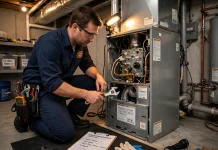
Otherwise, there is a risk that the attic will be damp. Another option is to improve ventilation using heat recovery or energy recovery ventilators. Such equipment actively transfers air through the duct, improving its quality and reducing losses. The functioning of these devices, as well as the associated filters, vents, and other equipment, requires periodic inspection and cleaning. Moreover, in the case of the suspected entry of moisture indoors without finding the source, an expert examination can be helpful. Specifically, a certified HVAC technician can evaluate the state of the heating or air conditioning system, the operation of which can also affect the observed humidity levels.
Maintaining the Heating System
A properly operated heating system facilitates consistent indoor temperatures, which is essential for withstanding the cold winter months. While a furnace itself is typically not a device to reduce indoor humidity, the knowledge about it can be useful for tackling this issue from a number of different angles. Heating rooms increases the capacity of the air to hold moisture, which means that its current content will be lower. Therefore, the use of a humidifier will be necessary to increase the levels of indoor humidity by adding the required amount of moisture. Maintaining the furnace also becomes a useful step for regulating the indoor temperature and humidity levels.
Generally, this procedure should not present serious problems for a homeowner. Typically, it is replacing batteries or filters substituted in the furnace, as well as controlling if its supply and intake vents are not obstructed in any manner. If the furnace produces strange noises, is too warm, is not able to establish an even temperature, or has other issues, consulting the advice of HVAC experts could be a wise idea. Specifically, a furnace repair Ottawa professional can review the current working and condition of the equipment, and suggest what actions should be executed to remedy the observed difficulties.
Preventing Window Condensation and Moisture Damage
Condensation occurs when warm and moist air touches a cool surface, which makes window glass one of the most common places where it occurs in winter. Under certain conditions, such episodes of condensation may become frequent, either because the ambient air simply has too much moisture for the temperature, or because the insulating properties of the window glass are insufficient. Either way, frequent condensation episodes will affect the overall humidity levels inside a house. They may also be detrimental to property, particularly to windows, if they occur frequently.
A similar scenario may play out if excessive levels of humidity make the surrounding elements damp, creating conditions for developing mold on the surface of the window or other objects. Preventative measures against these issues can be classified into two broad categories. One option is decreasing the levels of indoor humidity, if excessive. Another strategy, however, exists that does not require adjusting the indoor humidity. If heavy curtains collect warm and moist air, they may be worth replacing with lighter ones. As a general safety measure, any condensation that has appeared on the surface of the window glass should be removed immediately.
Monitoring Humidity and Adjusting Seasonal Habits
The regulation of the level of indoor humidity should be performed in such a way that neither excessive dryness nor excessive dampness develops. There are generally no constant laws about what levels of indoor humidity should prevail in winter. In practice, however, there are several important things to consider that can make the task easier. First of all, it would be useful for every homeowner to obtain an exact figure regarding the current indoor humidity levels. Using a hygrometer is recommended instead of estimating it based on how comfortable or otherwise the body feels during a given time. This is because these measurements will be needed when determining the direction in which the adjustment of these levels should proceed. The readings taken, as well as a review of a more comprehensive examination of the indoor humidity levels, can be used to estimate the amount of moisture and dry air that should be expected in winter. This is especially true when condensation occurs at some point or another when humidity levels remain unchanged.
In terms of seasonal adjustments, they usually involve changes to the activity of a humidifier, as well as ventilation methods and ways to reduce the effects of cold air infiltration into the house. They are not necessarily uniform across the entire house, as different rooms or areas of it have different conditions. Basements, for example, often contain unique aspects affecting the levels of indoor humidity that should be taken care of when adjusting them for the winter season. If these adjustments are not sufficiently successful, a more comprehensive examination by a specialist will likely be helpful. Both dry air conditions and damp environments will benefit from it, as the problem is solved either by increasing the room temperature or by enhancing the system of ventilation.
Conclusion
Humidified indoor air conditions in winter require a variety of considerations to ensure comfort at home, as well as protection against potential damage to the property. In essence, however, there are three major areas requiring homeowners’ attention: increasing the indoor humidity levels, reducing them, and improving ventilation. Each of these three tasks can be performed with relatively simple measures. First of all, a hygrometer must be used to check the current indoor humidity levels. This is followed by those necessary to increase these levels, if they are too low. The simplest way to achieve it is to use a humidifier. If these levels are too high, by contrast, eliminating any sources of excess moisture outdoors or indoors, as well as using fans, is required. Finally, ventilation must be improved, and it can be achieved by using attic fans, heat recovery or energy recovery ventilators, or other devices. If the identified problems persist, a professional evaluation by an HVAC technician is recommended. It can become a helpful measure both if the indoor humidity is excessively dry or, on the contrary, excessively wet.