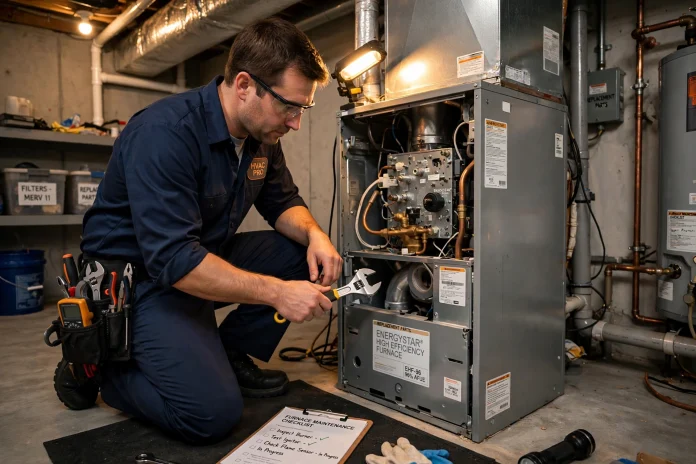
Your furnace never quits on a mild Tuesday afternoon in October. It quits at 6:40 PM on the coldest night of January, right as the kids get out of the bath and the wind starts pushing through the door seals.
That timing isn’t a coincidence, and it isn’t bad luck either. Cold snaps put every component in your system under peak load at the exact moment your house needs it most. Most failures have been building for weeks, quietly, in ways you could have caught with ten minutes of attention.
So here’s the goal for the next few minutes: help you figure out which problems you can handle yourself, which ones mean you need timely furnace repair services, and how to tell the difference before your pipes are involved. I’ve watched neighbors learn this the expensive way, and the pattern is almost always the same.
What Actually Happens Inside a Furnace in a Cold Snap
Your furnace isn’t one machine. It’s a chain: thermostat sends a signal, the inducer motor pulls air through, the pressure switch confirms the draft, the ignition lights the burners, the flame sensor verifies fire, and the blower pushes heat through the ducts. Break any link and the whole chain stops.
Modern furnaces are built with safety interlocks that shut the system down rather than run it in an unsafe condition. That’s a good thing. It’s also why you sometimes get a furnace that “runs for 30 seconds and stops” instead of a clear error message. The system is protecting you from a problem you can’t see.
Cold weather makes this harder on every part. The furnace runs longer cycles, cycles more often, and never gets the recovery break it gets in fall. Components that were marginal in November become failures in January.
According to the Department of Energy, heating and cooling account for the largest share of energy use in a typical American home. That single fact explains why a struggling furnace shows up on your utility bill before it shows up as a comfort problem.
The 72-Hour Rule I Use to Decide if It’s an Emergency
Here’s the framework I actually use, and you can steal it. Ask one question: can I keep the house above 55 degrees for the next 72 hours without the furnace?
If yes, you’re in a “schedule it tomorrow morning” situation. If no, you’re in a “call now, tonight” situation. Everything else is noise.
| Scenario | 72-Hour Test | What I’d Do
|
|---|---|---|
| Furnace runs but heats unevenly | Pass | Book a diagnostic visit this week |
| Furnace short cycles every few minutes | Fail in deep cold | Call today, don’t wait for it to stop entirely |
| No heat, temp holding above 55 | Pass | Morning call, run space heaters in one room |
| No heat, overnight low below 20 | Fail | Call for emergency service immediately |
| Gas smell or soot around the unit | Not applicable | Leave the house, call from outside |
The reason I lean on the 72-hour test is that it forces you to think about consequences, not feelings. A cold house is uncomfortable. Frozen pipes are a five-figure repair. Those are very different problems, and they deserve different responses.
Why the Same Furnace Quits Twice
I’ve seen this one play out on my own street. A furnace gets a cheap fix in December, runs fine for three weeks, then dies again in February. Everyone assumes the repair guy did bad work. Usually that’s not what happened.
What happens is the technician treated a symptom instead of the cause. A dirty flame sensor causes a lockout, so the sensor gets cleaned and the system restarts. But the sensor was dirty because the burners were running rich, and the burners were running rich because the gas pressure drifted. Two more service calls and you’ve paid for a repair that was never going to stick.
Good diagnostics work backward. The National Institute of Standards and Technology builds its entire measurement framework around traceability, the idea that you can’t fix what you can’t accurately measure. Furnace troubleshooting works the same way. A technician who checks static pressure, temperature rise, and gas pressure is measuring. A technician who swaps parts and hopes is guessing.
Ask which one you’re getting. It’s a fair question and any honest company will answer it.
What You Can Check in Ten Minutes
Before you call anyone, run this list. It won’t fix a broken furnace, but it will save you a service call fee on the calls where the answer is embarrassingly simple.
- Confirm the thermostat is set to Heat, not Auto or Cool, and the setpoint is above room temperature.
- Check the air filter. A clogged filter is the most common cause of a furnace that runs hot and shuts down early.
- Find the furnace switch. It looks like a light switch near the unit, and it does get flipped by accident.
- Look at the breaker panel for a tripped circuit.
- Check the intake and exhaust pipes outside for snow, ice, or a bird nest.
If all five check out and you still have no heat, stop poking at it. Gas appliances are not a hobby project. The Air Conditioning Contractors of America sets the industry standards that qualified technicians train against, which is the practical reason to hire someone certified rather than someone with a truck and a wrench.
What Furnace Repair Services Should Actually Tell You
When you call for furnace repair services, the technician should explain the problem in plain language before touching anything. You should know what part failed, why it failed, and what happens if you don’t fix it right now. Anything short of that and you’re being managed, not served.
You should also get an honest read on repair versus replace. The standard advice says replace when the repair cost exceeds a third of the price of a new unit, or when the furnace is past the end of its typical service life. I’d add a third condition that doesn’t get mentioned enough: replace if this is the second major failure in the same heating season. Two failures mean the system is telling you something about its overall condition.
And if someone quotes you a repair without ever testing the unit, get a second opinion. That’s not skepticism, it’s basic math.
Preventing the Next January Call
The single highest-return habit is a filter change every one to three months, depending on pets and how often the system runs. Everything else follows from that.
Book a tune-up in early fall, before the first cold snap fills every technician’s schedule. Have your ductwork checked if some rooms are always colder than others. Keep the area around the furnace clear so airflow isn’t restricted.
None of this is glamorous, and none of it guarantees your furnace won’t fail. But it shifts the odds, and in a Northern Ohio January, odds are what you’re working with.
Here’s the thing worth sitting with: your furnace gave you warnings last month. A rattle you ignored. A room that felt colder than it should. A bill that crept up. The question isn’t whether your system is talking to you. It’s whether you’re going to listen before it stops talking and starts costing you.