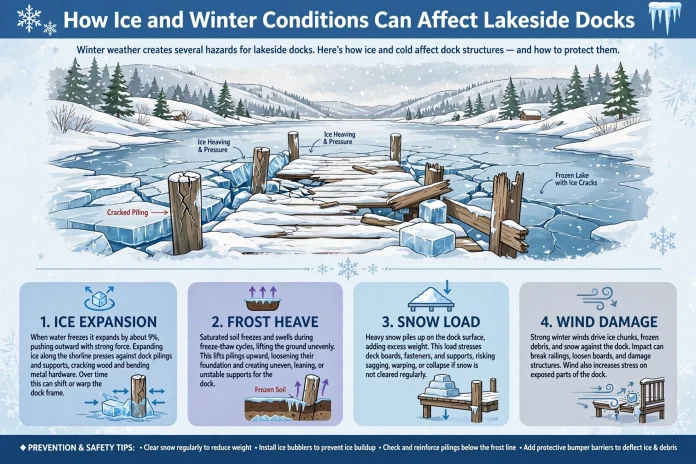
Docks at lakeside experience tough conditions throughout the entire winter season especially in places where there is freezing weather and formation of thick ice due to the cycle of freezing and thawing. The effects of ice include pressure exerted on the structure, impact on the connections, damage of the deck, as well as movement near support points. Other elements that contribute to stress include snow, winds, fluctuation of water level, and exposure to moisture for a long period of time.
Ice Pressure on Dock Structures
One of the most critical issues with regards to winter and a lakeside dock is the pressure buildup as the water turns into ice in relation to certain structures. The pressure is exerted due to the freezing process and ice expansion, which might affect the various structural elements of a dock including posts, frameworks, braces and others. Such pressure depends on the depth of water, temperature changes, the thickness of ice formation and the positioning of the dock with respect to the shore. Thus, the dock structure, which seems solid during the summer period, will be subjected to great pressure as a result of freezing.
Another factor affecting the stability of a dock is the constant freezing and thawing process. As the temperature drops, the ice freezes and melts. During melting, the ice shifts its pressure around the supports and connections of the dock structures. The shifting may cause loosening of the fasteners and damage to the joints.
Effects on Dock Supports
In addition, dock supports are especially crucial during winter, since they transmit weight from the dock to the lake bed or shoreline. Ice movement near such supports can create lateral force which could impact the position of supports. Posts could be strained in case ice freezes around them and moves due to wind action or changes in water level on the surface of ice.
Furthermore, the state of the surrounding shoreline could affect the impact of winter conditions on a dock. The areas of the shoreline subject to ice movement could be subjected to erosion or changes in soil or ground near support points. For this reason, the condition of the dock and its contact point with the shoreline should be considered by cottage owners.
Damage to Dock Decking
There is a possibility that wooden or composite decks may have different reactions to winter wetness, cold and weather changes. The wetness may affect wooden planks as they will absorb water and will expand and contract depending on the temperature and moisture. Trapped wetness around the fastenings or between boards can cause damage to the surface due to freezing. Any cracks, splits or weak spots can appear after the winter season.
The appropriate gap between the planks will let water go through the deck surface and give the ability for natural movement. In case of renovation of the docks, any damaged planks should be examined but not only covered. The fastenings also should be inspected as the movement of planks creates extra stress for them.
Effects on Dock Hardware
The hardware can also experience damage due to winter effects. If there is moisture in the areas where screws, brackets, hinges, and other fasteners connect, they may corrode from exposure to moisture and cold. Hardware that corrodes will weaken over time and make removal during the necessary repair difficult.
The motion of ice can put extra strain on the joints. An already weak joint may have difficulty coping with the constant motion in winter months. Therefore, it is wise to use the right hardware suitable for a wet environment for the renovation or repair of the dock. Existing joints should be inspected before winter in order to replace any damaged parts.
Water Levels and Winter Movement
Fluctuations in water levels create a difficult situation for lakeside docks in winter. Such fluctuations can be caused by weather patterns, drainage systems, lake management, or spring melt. The ice that forms during these fluctuations moves either vertically or horizontally relative to dock elements. These movements can put additional stress on elements that would otherwise not be exposed to such stress in the absence of ice.
Dock owners should also take into account the orientation of their docks in relation to fluctuating water levels. A dock that is perfectly appropriate for use in summer might need additional care during the winter as the water level and shoreline shift. This becomes especially important for those docks that are connected to boat storage facilities or lift systems. For instance, a boat house cable lift Muskoka might require correct alignment of the dock and its elements despite changing seasons.
Snow and Weight on Dock Surfaces
Another source of winter stress that snow could cause would be related to the weight of snow buildup. In small amounts, it might not pose any structural danger, but large amounts could put extra strain on the structure of the dock. Snow that holds moisture in it is heavier and could put additional strain on decking, framing, and structural elements. This could be especially noticeable in old docks, where some of the elements of its structure had been weakened.
Another issue is that snow could hide potential issues with the dock itself. For example, cracks, broken boards, loose elements, and other similar things could be hard to notice due to the snow covering them. Leaving snow to accumulate without disturbing it could mean an extra workload and difficulty in checking the condition of the structure.
Wind and Moving Ice
The wind in winter is capable of pushing the ice on the lake surface and adding extra stress to the dock. Large ice sheets can be shifted either towards or away from the shore as the result of wind blowing. If such moving ice hits the dock structure, it can cause impact loads, rubbing loads or lateral pressures on structural members. All these loads can get stronger during temperature fluctuations.
The behavior of ice is hard to predict because the situation can change rapidly due to weather conditions. Thus, the calm frozen lake can suddenly become active due to temperature rise or strong wind. The docks that are situated in open areas will be subjected to different winter stresses than the docks that are sheltered by natural shoreline features.
Preparing Docks Before Winter
Winter preparation can mitigate some of the dangers that freezing poses. The dock should be examined for issues with its decking, framing, supporting beams, fasteners, brackets, and connections prior to winter weather. Any damaged components can be repaired ahead of time, when freezing weather does not interfere with such work. Removal of unnecessary equipment from the dock can decrease the area where the dock is exposed to winter elements.
The proper approach for winter preparation may vary, depending on the type of dock and the lake conditions. Some of the docks are meant to be taken out seasonally, while others stay put throughout winter. It is necessary to know which type of dock you have to maintain it properly. If there are any structural concerns with your dock, they need to be addressed by a professional.
Spring Inspection After Ice
A good time to conduct a thorough analysis of a dock located near a lake is at the end of the winter season. Once it is clear that there are no threats to the safety of the structure from the presence of ice on the water and on land, one can start checking the dock for signs of movement and deterioration. This should be done particularly paying attention to such elements as the supports, connections, decking, fastenings, and connections of the dock with the shoreline.
Also, one can detect a number of problems that could not be noticed earlier since they are caused by gradual deterioration of the dock over time. For example, a small movement that was hardly noticeable before could be detected after months of freezing and thawing, and a crack that could go unnoticed might have developed during the winter.
Issues related to ice and winter weather can impact many components of a lakeside dock, including structural supports, the dock itself, hardware components, as well as attachments to the shore line. The stresses due to freezing and melting, ice movement, water level changes, snow, and high winds can all be unique and may require different actions to prepare the dock for winter and ensure that it is in good condition in the spring. This understanding is particularly helpful for renovating docks as renovations may take into consideration winter issues and local climate conditions.