If you’re anything like me and constantly dealing with pics – receipts, product shots, scanned notes, random docs – you know the pain of trying to convert a simple JPG into a clean, decent-looking PDF. I swear, every time I needed to do it fast, something went sideways. I’d pull up some “free JPG to PDF converter” and boom – slow loading, weird menus, hidden paywalls, or the classic: “Download available only in Pro version.” Like bro, seriously?
Half the time, I’d upload a photo and the PDF would come out blurry as heck, the layout would look crooked, or the tool would suddenly ask me for money right before download. And don’t even get me started on the tools that take forever to convert one single file. If your task involves multiple pics? Yeah, good luck – that’s when the headache really starts.
After dealing with this mess one too many times, I finally decided to test a bunch of JPG to PDF tools side by side and just figure out what actually works.
How I Tested Every JPG to PDF Tool?
To keep everything fair, I used the same setup for each tool.
My Test Files
- 10 JPG photos
- Each is around 3–5 MB
- Resolution: 2400×1600 px
- Mix of scanned notes, product photos, and digital graphics
What I Paid Attention To
- Speed – How fast it converts single/multiple images
- Ease of Use – Is the interface simple or annoying?
- Accuracy – Does the PDF look exactly like the original JPG?
- Batch Converting – Can it merge multiple JPGs into one PDF?
- Features – compression, layout, orientation, etc.
- Pricing – limits, hidden paywalls, watermarks
- Final Output – sharpness, color accuracy, layout cleanliness
I wanted real answers – not marketing hype – so I basically convert image to pdf format the way I’d use them for my daily work.
Platforms I Have Tested
1. iLovePDF2.com
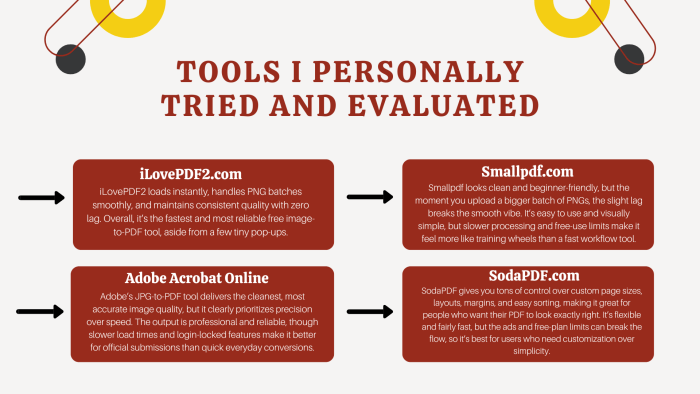
The second I landed on iLovePDF2’s jpg to pdf converter page, it felt like the tool was already waiting for me. No loading delay, no confusing buttons – just a big clean space to drop my files. It gave me relax, I got you energy!. I tossed in a bunch of PNGs, and the preview popped up instantly, like the tool was reading my mind.
What Stood Out
- Super fast file detection
- Batch conversion that actually works
- You can reorder PNGs without glitches
- Quality stays consistent
- Zero confusion in the layout
Even when I threw in big, high-res PNGs, the tool zipped through them like it wasn’t even trying. No laggy animations. No spinning wheels. Just straight efficiency.
Pros:
- Fastest overall workflow
- Most reliable PNG handling
- Layout is clean and not stressful
Cons:
- Tiny pop-up reminders
Quick Verdict
If converting images is something you do often – or you just hate slow or paid tools – i Love PDF 2 is the one that never lets you down.
2. Smallpdf.com
SmallPDF felt almost… cozy: big soft edges, clean colors, simple steps. The whole interface gives “don’t worry, you won’t mess this up.” It’s definitely aimed at people who want a stress-free, guided experience – but honestly, the moment I tried uploading a bigger batch of PNGs, the tool hesitated. It hung for a couple seconds, and for a split second I thought the page froze. That little lag kinda killed the smooth vibe.
What It Offers
- A super visual upload area
- Easy sorting and rearranging
- Good for simple combining
- Quick margin + orientation adjustments
My Experience
I dropped in my PNGs, clicked a few straightforward buttons, and the final PDF popped out in seconds. Smooth, predictable, but definitely slower than iLovePDF2 – like it takes its time to think.
Pros
- Perfect for beginners
- Looks clean and modern
- Simple steps, no guesswork
Cons
- Processing is slower
- Free version cuts you off after a few tasks
Quick Verdict
If you’re not tech-savvy and just need a clean, friendly tool, Smallpdf feels like the training wheels everyone can use, but it’s not fast as i want.
3. Adobe Acrobat Online
Opening Adobe’s image jpg to pdf page feels like switching into work mode. The page has that polished corporate vibe – nothing playful, nothing extra. I uploaded my PNGs and Adobe instantly made it clear: this tool is built for precision, not speed.
Main Features
- Best color accuracy
- Super clean merging
- Trusted formatting
- Syncs with Adobe apps
- Great compatibility
My Experience
Adobe’s output is seriously impressive. Every detail from the original PNG – shading, clarity, contrast – came out sharp. But you can definitely feel the heavier load time. It’s like converting files with a high-end camera… amazing quality, but no shortcuts.
Pros
- Best image quality
- Very reliable for professional use
- Secure platform
Cons
- Slower compared to others
- Some features hide behind login
Quick Verdict
If you’re submitting something official (like applications or client files), Adobe is the safest choice.
4. JPG2PDF.com
I tried JPG2PDF, and honestly, it was stupid easy to convert my JPGs to PDF: drag, drop, done. It was on point with speed, no doubt. But when I opened the final PDF, the quality took a hit. The images turned out a bit washed out and softer than the original ones, like the tool squeezed them too hard during compression. Fast? Yes. Clean quality? Not really.
Main Features
- No account needed
- Free unlimited conversions
- Batch support
- Very tiny processing time
- Lightweight interface
My Experience
I added about a dozen PNGs and the site spit out the PDF almost instantly — legit faster than I could scroll. But with that speed comes zero customization. It’s like a fast-food drive-thru: quick and basic.
Pros
- Fastest raw speed
- No sign-in, no waiting
- Completely free
Cons
- No layout or quality controls
- UI looks outdated
Quick Verdict
Perfect when you need a PDF RIGHT NOW and don’t care about the custom features.
5. SodaPDF.com
I found lots of knobs, lots of settings, lots of room to experiment. It’s clearly made for people who want to tailor their output rather than just convert jpg to pdf online.
Main Features
- Custom page sizes
- Layout templates
- Adjustable margins
- File dragging & sorting
- Decent speed
My Experience
I adjusted the margins, changed the alignment, and even tested different layouts before converting. It’s flexible, but the ads and restrictions get annoying fast if you’re using the free version.
Pros
- Most customization options
- Good conversion speed
- Pretty easy to navigate
Cons
- Ads can interrupt the flow
- Free plan has limits
Quick Verdict
If you want your PNGs to look a certain way in PDF form – precise spacing, size, orientation – SodaPDF gives you the control others don’t.
PDF Tool Comparison Table
| Tool | Speed | Image Quality | Free Limitations | Best For |
|---|---|---|---|---|
| iLovePDF2 | ★★★★★ | ★★★★★ | Light limits | Everyday users needing speed |
| Smallpdf | ★★★★☆ | ★★★★☆ | Daily limits | Beginners, simple tasks |
| Adobe Acrobat | ★★★☆☆ | ★★★★★ | Some login features | Professionals, official work |
| JPG2PDF | ★★★★★ | ★★★★☆ | None | Instant conversions |
| SodaPDF | ★★★★☆ | ★★★★☆ | Feature restrictions | Users needing customization |
Which Tool Fits Which User?
Fastest option: iLovePDF2.com
Best for quality: Adobe Acrobat & iLovePDF2
Best overall for most users: iLovePDF2
Best for beginners: iLovePDF2 and Smallpdf
Best for customization: iLovePDF2 and SodaPDF
Suggestions For Improvement
According to my personal experience, i’m suggesting below points to all tools that I tested.
iLovePDF2.com
- Add a dark mode for people working at night.
- Reduce the occasional pop-up nudges; they disrupt the clean experience.
- Add a quick “before vs after quality preview” option.
Smallpdf.com
- Boost the processing speed – especially for large PNG batches.
- Increase the free daily task limit so people can test more features.
- Add more layout options like spacing controls and page padding.
- Let users drag-to-resize thumbnails inside the preview window.
- Reduce the number of steps required before downloading.
Adobe Acrobat Online
- Improve load times on the turn jpg into pdf page; it feels heavier than needed.
- Make basic features available without logging in.
- Add an offline “quick convert” mode for users in a hurry.
- Provide more export formats beyond the default PDF settings.
- Simplify the interface for first-time users; it feels very corporate.
JPG2PDF
- Modernize the UI without slowing down the tool.
- Add basic customization like margins or orientation.
- Let users preview PNGs before generating the PDF.
- Offer optional quality settings (low/medium/high).
- Add a dark mode – the current white page is blinding.
SodaPDF.com
- Tone down the ads; they interrupt the workflow heavily.
- Improve mobile optimization so users can convert PNGs easily on phones.
- Add clearer labeling for advanced layout settings.
- Reduce the loading time between steps when customizing pages.
- Include a real-time preview while adjusting margins or page size.
The Bottom Line
Converting JPGs into clean, pro-looking PDFs doesn’t have to feel like a chore. I tested all these tools so you don’t have to, and honestly, there’s something for everybody.
- If you want the best all-around experience, go with iLovePDF2.com.
- If you want top-tier quality, Adobe’s the champ.
- If you want instant speed with no sign-up, JPG2PDF wins.